From CU-Bloomsburg classrooms to the Army's digital front lines
Cybersecurity graduate realizes military dreams after medical setback
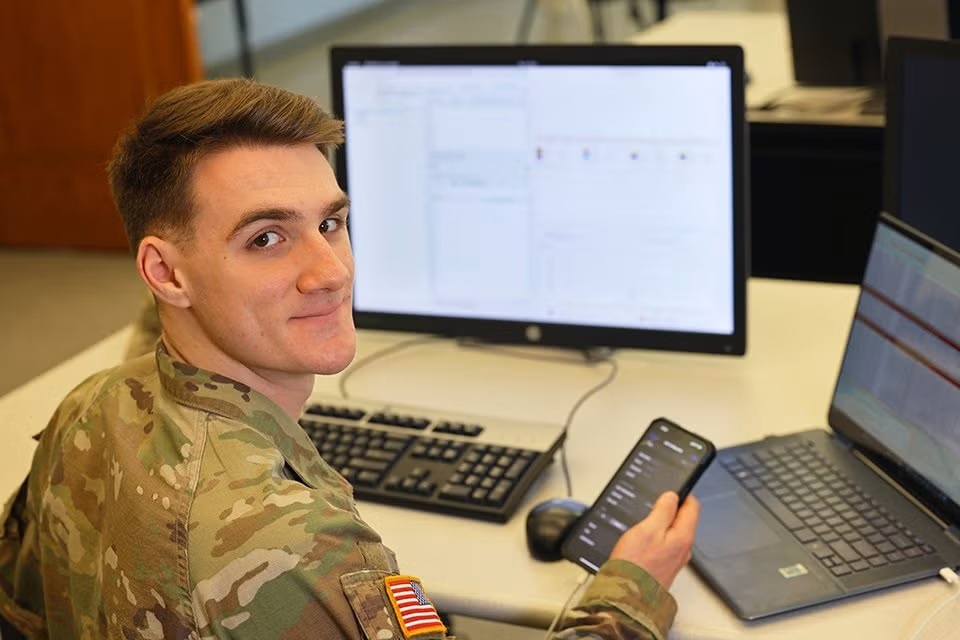
BLOOMSBURG, Pa. (05/28/2026) — In four short years, Tanner Donahue went from having his military dream seemingly end before it even began to landing one of the most coveted and selective commissions in the Army.
The recent Commonwealth University-Bloomsburg digital forensics and cybersecurity graduate and ROTC cadet turned that closed door into a successful mission of transforming a medically disqualified recruit into a cyber-focused Army officer.
Donahue's plan was simple. Enlist right after high school graduation and serve. Allergy-induced asthma ended that dream, leaving him certain the Army wouldn't take him.
"They weren't medically accepting me," he said. "I've always had a drive to serve and do my part, then suddenly that door felt closed."
It reopened in an unexpected place, in a campus weight room.
Through Bloomsburg's Strength and Fitness Club, Donahue met an ROTC cadet, who told him about new medical waivers and invited him to check out the program. Donahue didn't yet know the difference between enlisting and commissioning through ROTC. He just knew after that first meeting he'd found a path to serve and a community that would shape him into the leader he wanted to become.
"I wanted to learn as much as I possibly could and be the best version of myself," Donahue said. "This was absolutely the way to go."
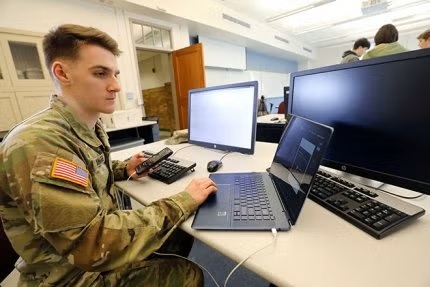
It was digital forensics and cybersecurity that drew Donahue to Bloomsburg for the nationally recognized bachelor's program that's designated a National Center of Academic Excellence in Cyber Defense Education because of its specialized labs and professional grade tools for investigating cybercrime and securing networks.
In high school, Donahue, of Narvon, loved taking computers apart, experimenting with code and digging into how systems worked. When a career search turned up "digital forensic analyst," he saw a way to serve through law enforcement or a federal agency if the military remained off limits.
Weighing other college options like Penn State and Alvernia, he determined Bloomsburg's program stood out for its focus on digital forensics and cyber defense rather than general computer science, and for a close-knit campus that immediately felt like home.
"I went on a tour, and it felt like where I was supposed to be," Donahue said. "Bloomsburg had everything I wanted in a college experience."
Once on campus, Donahue realized he could take on more. Through ROTC he met upper-class cadets successfully double majoring, which pushed him to add criminal justice to his digital forensics and cybersecurity degree. In the classroom, courses like security fundamentals and penetration testing showed him how hackers think, how attacks unfold and how to harden systems against intrusions.
He still uses the tools and techniques from those classes to protect his own devices and to help others avoid digital pitfalls.
"I thought my drive for cyber was already maxed out," Donahue said. "Then I took penetration testing, and somehow I want it even more now."
Criminal justice courses, especially criminology and a seminar on gangs, added a human dimension to his technical skills. They helped him imagine how people behave behind the keyboard, giving him ideas about where to look for digital evidence and how to read between the lines of a hard drive.
Donahue officially joined Army ROTC late in his sophomore year. In less than three years, he rose to battalion executive officer for the Bison Battalion, which includes cadets at Bucknell, Bloomsburg and other regional campuses. Along the way, he completed both Basic and Advanced Camp at Fort Knox, earned a highly competitive slot at Air Assault School and balanced that training with his demanding double major.
"Like most college kids, when you get to campus you're out partying and meeting people," Donahue said. "ROTC taught me accountability and responsibility - o wning my mistakes, learning from them and not letting them define me."
Field exercises, leadership labs and high-stress events like the Army 10-Miler, the Norwegian Foot March and Ranger Challenge forced him to develop as a communicator who can keep teams focused when the pressure spikes.
As battalion executive officer, he led through relationships. Donahue worked across the battalion's staff sections to coordinate training, logistics and administration for cadets on multiple campuses.
Because he joined ROTC late, Donahue packed years of training into a tight timeframe. He went through Fort Knox twice. First for Basic Camp, a month-long immersion in soldier skills and Army values. Later for Advanced Camp, which is the capstone evaluation that feeds into the national Order of Merit List for branch selection.
When his platoon lost several cadets at Advanced Camp, more leadership opportunities opened; Donahue stepped into four different roles, including platoon leader and platoon sergeant, learning to adapt and perform under constant scrutiny.
Air Assault School - often called "the 10 hardest days in the Army" - pushed him even further. Donahue spent two weeks mastering helicopter operations, sling load rigging and high-tower rappelling. The second phase, focused on sling loads, drove home just how critical precision is when lives and aircraft are on the line. The final test, rappelling from a helicopter at roughly 100 feet, brought everything together.
"Once they tell you you're good to go, you leave all that stress on the helicopter," Donahue said. "You jump, let the rope take control, and you can see the entire course you've just spent three phases working through."
Those experiences changed how he looks at time, discipline and balance. At Air Assault he once had to learn roughly 25 pages of material in three nights making a week for a class assignment feel generous. That perspective made it possible to juggle a full slate as battalion executive officer, president of the Student Veterans Association, campus employment, two majors and a personal life.
"After going, I realized every minute is important," Donahue said. "If you plan it out and use what you've learned, you can do far more than you think."
Donahue's sights are set on the Army's digital battlefield. His top branch choice is cyber, one of the most competitive and selective branches for new officers, where a small number of lieutenants are chosen to conduct offensive and defensive operations in cyberspace, protect critical networks and shape the information environment for commanders.
Cyber is where his academic and ROTC experiences intersect most directly. The same skills he used in Bloomsburg's cyber labs - analyzing digital evidence, probing networks for vulnerabilities, designing and securing systems - map onto the missions of Army cyber units tasked with defending U.S. networks and disrupting adversaries in the digital domain.
"With digital forensics and cybersecurity as one of my majors, I love the game," Donahue said. "Taking that into the military, conducting cyber warfare possibly against a foreign adversary, feels like the best way with my skill set to give back to a nation that's given me so much."
The branching process includes an asynchronous interview and a specialized cyber interview, and Donahue knows slots are limited. But he also knows he's done everything he can with strong Advanced Camp scores, a physically demanding resume capped by Air Assault, deep involvement on campus and a degree from a nationally recognized cyber program.
Looking back through his time navigating Bloomsburg's computer labs and ROTC exercises to the Fort Knox training ranges and the rappel towers of Air Assault, Donahue is proud of how far he's come.
"I'm definitely not the same person I was when I first came the Bloomsburg in the best way possible," he said, adding his transformation will continue on a new front line - inside some of the most critical networks in the world.
Media Attachments
Tanner Donahue
Tanner Donahue